
This information is for you if your baby remains in the breech position after 36 weeks of pregnancy.
Babies lying bottom first or feet first in the uterus (womb) instead of in the usual head-first position are called breech babies. It may also be helpful if you are a partner, relative or friend of someone whose baby is breech towards the end of their pregnancy.
The information here aims to help you better understand your health and your options for treatment and care. Your healthcare team is there to support you in making decisions that are right for you. They can help by discussing your situation with you and answering your questions.
Within this information, we may use the terms ‘woman’ and ‘women’. However, we know that it is not only people who identify as women who may need to access this information. Your care should be appropriate, inclusive and sensitive to your needs whatever your gender identity.
A glossary of all medical terms is available on the RCOG website at: https://www.rcog.org.uk/for-the-public/a-z-of-medical-terms/
Key points
- Breech is very common in early pregnancy, and by 36–37 weeks of pregnancy most babies will turn into the head-first position. If your baby remains breech, it does not usually mean that you or your baby have any problems.
- Turning your baby into the head-first position so that you can have a vaginal delivery is a safe option.
- The alternative to turning your baby into the head-first position is to make plans for a Caesarean birth or a planned vaginal breech birth.
Babies lying bottom first or feet first in the uterus (womb) instead of in the usual head-first position are called breech babies. Breech is very common in early pregnancy, and by 36–37 weeks of pregnancy, most babies turn naturally into the head-first position.
Towards the end of pregnancy, only 3–4 in every 100 babies are in the breech position.
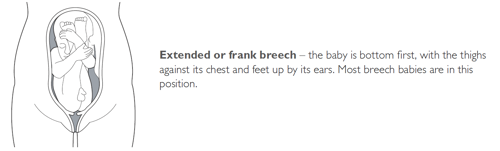
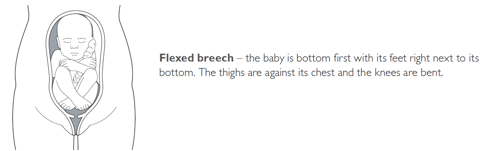
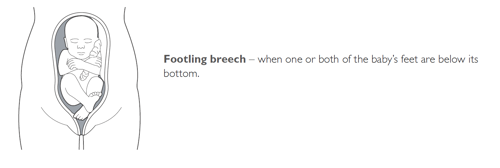
A breech baby may be lying in one of the following positions:
Extended or frank breech – the baby is bottom first, with the thighs against its chest and feet up by its ears. Most breech babies are in this position.
Flexed breech – the baby is bottom first with its feet right next to its bottom. The thighs are against its chest and the knees are bent.
Footling breech – when one or both of the baby’s feet are below its bottom.
It may just be a matter of chance that your baby has not turned into the head-first position. However, there are certain factors that make it more difficult for your baby to turn during pregnancy and therefore more likely to stay in the breech position. These include:
- if this is your first pregnancy
- if your placenta is in a low-lying position (also known as placenta praevia); see the RCOG patient information on having a low-lying placenta (placenta praevia) after 20 weeks
- if you have too much or too little waters (amniotic fluid) around your baby
- if you are having more than one baby.
- if your uterus (womb) is an unusual shape (congenital uterine anomaly)
Very rarely, breech may be a sign of a problem with the baby. If this is the case, such problems may be picked up during your 20 week scan.
If your baby is breech at 36 weeks of pregnancy, your healthcare professional will discuss the following options with you:
- trying to turn your baby in the uterus into the head-first position by external cephalic version (ECV)
- planned caesarean birth
- planned vaginal breech birth.
What does ECV involve?
ECV involves the healthcare professional applying pressure with one or both hands on your abdomen to help your baby turn in the uterus to lie head-first. ECV can be painful but the experience is different for everyone. For some women, ECV may cause too much pain.
Relaxing the muscle of your uterus with medication has been shown to improve the chances of turning your baby. This medication (usually Terbutaline) is given by injection before the ECV and is safe for both you and your baby. It may make you feel hot and light-headed and you may become aware of your heart beating faster than usual, but this will only be for a short time.
Before the ECV you will have an ultrasound scan to confirm your baby is breech, and your pulse and blood pressure will be checked. After the ECV, the ultrasound scan will be repeated to see whether your baby has turned. Your baby’s heart rate will also be monitored before and after the procedure.
Please contact your local hospital if you have any of the following after the ECV:
- bleeding
- abdominal pain
- contractions
- changes in your baby’s movements.
Your healthcare team will offer you an ECV around 36 or 37 weeks of pregnancy. However, you can have an ECV right up until the early stages of labour. You do not need to do anything to prepare yourself for your ECV.
ECV can be uncomfortable and sometimes painful, but your healthcare professional will stop if you are in pain. If your healthcare professional is unable to turn your baby then, with your consent, they may try again on another day.
If your blood type is rhesus D negative, you will be advised to have an anti-D injection after the ECV and to have a blood test. See the NICE patient information Routine antenatal anti-D prophylaxis for women who are rhesus D negative.
Why turn my baby head-first?
If you are planning a vaginal birth, turning your baby around lowers your chances of needing a caesarean birth and its associated risks. If your plans are to have a caesarean birth anyway, you will most likely not be offered ECV.
Is ECV safe for me and my baby?
ECV is generally safe with a very low complication rate. After your baby has been turned, you will normally be able to go home on the same day.
However, immediately after ECV, there is a 1 in 200 chance of you needing an emergency caesarean birth because of bleeding from the placenta and/or changes in your baby’s heartbeat. ECV should be carried out by a doctor or a midwife trained in ECV. It should be carried out in a hospital where you can have an emergency caesarean birth if needed.
When you do go into labour, your chances of needing an emergency caesarean birth, forceps or vacuum (suction cup) birth is slightly higher than if your baby had always been in a head-down position. Your baby may be more likely to need care in the neonatal unit but the immediate condition of babies born following ECV does not appear to be much different compared to babies who have not been turned in the uterus (womb). Overall, there does not appear to be an increased risk to your baby from having ECV.
ECV can be offered to most women, even if they have had one caesarean birth before.
ECV should not be carried out if:
- you need a caesarean birth for other reasons, such as placenta praevia; see the RCOG patient information Placenta praevia, placenta accreta and vasa praevia
- you have had recent vaginal bleeding
- your baby’s heart rate tracing (also known as CTG) is abnormal
- your waters have broken
- you are pregnant with more than one baby; see the RCOG patient information Multiple pregnancy: having more than one baby.
Does ECV always work?
ECV is successful for about 1 in 2 women. It is more likely to work if you have had a vaginal birth before. Your healthcare team should give you information about the chances of your baby turning based on their assessment of your pregnancy.
If your baby does not turn then your healthcare professional will discuss your options for birth (see below). It is possible to try to turn your baby again, on a different day.
If your healthcare professional is able to turn your baby, there is still a small chance that your baby will turn back to the breech position. However, this happens to less than 5 in 100 women who have had a successful ECV.
Is there anything else I can do to help my baby turn?
There is no scientific evidence that lying down or sitting in a particular position can help your baby to turn. There is some evidence that burning a Chinese herb called mugwort (moxibustion) at 33–35 weeks of pregnancy may help your baby to turn into the head-first position, possibly by encouraging your baby’s movements. This should be performed under the direction of a registered healthcare practitioner.
Depending on your situation, your choices are:
- planned caesarean birth
- planned vaginal breech birth.
There are benefits and risks associated with both caesarean birth and vaginal breech birth. Your healthcare team should discuss this with you so that you can choose what is best for you and your baby.
Caesarean birth
If your baby remains breech towards the end of pregnancy, you should be given the option of a caesarean birth. Planned caesarean birth is safer for your baby than a planned vaginal breech birth.
The risk of a breech baby dying at planned caesarean birth is 1 per 2000 births and the risk of a breech baby dying at planned vaginal birth is 4 per 2000 births. This compares to a risk of 2 per 2000 for a planned vaginal birth when the baby is head-first.
Planned vaginal breech birth has not been shown to increase long-term problems in childhood or later life.
Caesarean birth can increase your chances of problems in future pregnancies. These may include placental problems, difficulty with repeat caesarean section surgery and a small increase in stillbirth in subsequent pregnancies.
If you have chosen to have a planned caesarean birth but you go into labour before this, your healthcare professional will examine you to assess whether it is safe to go ahead. If the baby is close to being born, it may be safer for you to have a vaginal breech birth. For more information, see the RCOG patient information Considering a caesarean birth.
Vaginal breech birth
After talking with your healthcare professional, you may choose to have a vaginal breech birth.
If you choose this option, you will need to be cared for by a team trained in helping women to have breech babies vaginally. You should plan a hospital birth where you can have an emergency caesarean birth if needed, as 4 in 10 women planning a vaginal breech birth end up needing to have a caesarean birth. Induction of labour is not usually recommended.
While a vaginal birth carries the least risks for you, it carries a small increased risk of your baby dying around the time of delivery. A vaginal breech birth may also cause serious short-term complications for your baby. However, these complications do not seem to have any long-term effects on your baby. Your healthcare team should talk about your individual risks with you.
Your healthcare team may advise against a vaginal birth if:
- one or both of your baby’s feet are below its bottom (footling breech)
- your baby is larger or smaller than average (your healthcare team will discuss this with you)
- your baby is in a certain position, for example, if its neck appears very tilted back on ultrasound images (hyper extended)
- you have a low-lying placenta (placenta praevia); see the RCOG patient informationPlacenta praevia, placenta accreta and vasa praevia
- you have pre-eclampsia or any other pregnancy problems; see the RCOG patient information Pre-eclampsia. .
With a breech baby you have the same choices for pain relief as with a baby who is in the head-first position. If you choose to have an epidural, there may be an increased chance of a caesarean birth. However, whatever you choose, a calm atmosphere with continuous support should be provided.
If you have a vaginal breech birth, your baby’s heart rate will usually be monitored continuously as this has been shown to improve your baby’s chance of a good outcome.
As with babies who are lying head first, there are some circumstances in which you may be offered an emergency caesarean birth, for example, if there are concerns about your baby’s heart rate or if there is delay in your labour. A healthcare professional trained in looking after newborn babies, such as a neonatal doctor or nurse, will be present at the birth.
If you go into labour before 37 weeks of pregnancy, the balance of the benefits and risks of having a caesarean birth or vaginal birth changes and will be discussed with you.
If you are having twins and the first baby is breech, your healthcare professional will usually recommend a planned caesarean birth.
If, however, the first baby is head-first, the position of the second baby is less important. This is because, after the birth of the first baby, the second baby has lots more room to move. It may turn naturally into a head-first position or a doctor may be able to help the baby to turn. See the RCOG patient information Multiple pregnancy: having more than one baby,
If you would like further information on breech babies and breech birth, you should speak with your healthcare professional.
Further information
If you are asked to make a choice, you may have lots of questions that you want to ask. You may also want to talk over your options with your family or friends. It can help to write a list of the questions you want answered and take it to your appointment.
Ask 3 Questions
To begin with, try to make sure you get the answers to 3 key questions, if you are asked to make a choice about your healthcare:
- What are my options?
- What are the pros and cons of each option for me?
- How do I get support to help me make a decision that is right for me?
*Ask 3 Questions is based on Shepherd et al. Three questions that patients can ask to improve the quality of information physicians give about treatment options: A cross-over trial. Patient Education and Counselling, 2011;84:379-85
Further information
NHS Choices: https://www.nhs.uk/pregnancy/labour-and-birth/if-your-baby-is-breech/
National Childbirth Trust (NCT): www.nct.org.uk/birth/breech-birth
Sources and acknowledgements
This information has been developed by the RCOG Patient Information Committee. It is based on the RCOG Green-top Clinical Guidelines No. 20a External Cephalic Version and Reducing Incidence of Term Breech Presentation and No. 20b Management of Breech Presentation. The guidelines contain a full list of the sources of evidence we have used.
First published in July 2017; updated July 2026