
This information is for you if you have a Bartholin’s cyst or abscess.
It explains what a Bartholin’s cyst and a Bartholin’s abscess are, and what the treatments can involve.
This information may also be helpful if you are a partner, relative or friend of someone who has a Bartholin’s cyst or Bartholin’s abscess.
The information here aims to help you better understand your health and your options for treatment and care. Your healthcare team is there to support you in making decisions that are right for you. They can help by discussing your situation with you and answering your questions.
Within this leaflet we may use the terms ‘woman’ and ‘women’. However, we know that it is not only people who identify as women who may want to access this leaflet for information. Your care should be appropriate, inclusive and sensitive to your needs whatever your gender identity.
A glossary of all medical terms is available on the RCOG website at: https://www.rcog.org.uk/for-the-public/a-z-of-medical-terms/
Key points
- A Bartholin’s cyst or Bartholin’s abscess can be a painful swelling of the vulva.
- It is diagnosed by an examination of the vulva.
- Treatment options include a ‘watch and wait’ approach, antibiotics, or draining with a catheter or an operation.
- Bartholin’s cyst and abscess can happen again even after treatment.
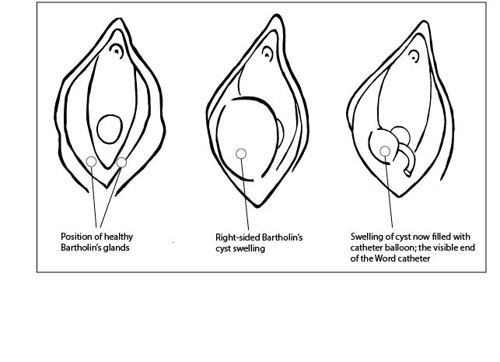
Bartholin’s glands are found on each side of the vaginal opening (see the diagram below). These glands release fluid through small tubes called ducts into the vagina, which acts as lubrication. When these ducts become blocked, the fluid gets trapped and forms a cyst. This is known as a Bartholin’s cyst. It is not always painful, but you may feel some swelling and discomfort. With your consent, your healthcare professional can diagnose this by examining you.
If the Bartholin’s cyst gets infected, this is known as a Bartholin’s abscess. These can be very painful, hot to touch, and you may notice swelling and redness of the skin next to it. You may find it painful to sit down or walk. You might notice some pus leaking from the abscess which may have an unpleasant smell.
Around 2 in 100 women will develop a Bartholin’s cyst or abscess at some stage in their life. It is unclear why the ducts can become blocked, and a cyst or abscess can happen for no particular reason.
Bartholin’s cysts that are not infected and not causing any symptoms do not usually need treatment.
There are three treatment options that you may be offered. This will depend on your symptoms, whether the cyst has started to leak fluid, and on the size of the cyst.
Having any of these treatments does not prevent another cyst or abscess from developing again in the future.
Non-surgical options
‘Watch and wait’
Your healthcare professional may not recommend treatment if your cyst or abscess is:
- small (less than 3cm across)
- leaking fluid, or
- not causing you pain.
This is because the cyst or abscess is likely to heal on its own. If you have an abscess, pain relief along with soaking the area in warm water may help.
Antibiotics
If the skin next to the Bartholin’s cyst is red, swollen or painful, it may be infected. You may be offered antibiotics to reduce your symptoms and help the cyst to heal.
Surgery
If your Bartholin’s cyst or abscess is bigger than 3cm across, is causing a lot of symptoms, or other treatments have not worked, you may be offered surgery. Surgical treatment for a Bartholin’s cyst aims to keep the duct open to allow the cyst to drain and then heal.
‘Marsupialisation’
This procedure involves making a small cut in the skin over the cyst or abscess to drain the fluid or pus inside. The edges of the cyst or abscess are then stitched (using dissolving stitches) to keep the edges open and allow fluid to continue to drain out. This procedure takes around 10-15 minutes and can be done when you are awake (using local anaesthetic) in the clinic, or when you are asleep (under general anaesthetic) in the operating theatre.
Sometimes a long thick thread (wick) may be inserted into the Bartholin’s gland to encourage all of the trapped fluid to drain. The wick can be removed at the hospital or you may be advised how to take it out yourself at home after a day or two. You should avoid using tampons or having sex within 5 days of marsupialisation.
If you have a general anaesthetic, you will be able to go home 4-6 hours after the procedure. You should not drive for a minimum of 24 hours after having general anaesthetic, so you will need to arrange to be picked up after the procedure.
Word balloon catheter
The healthcare professional will inject local anaesthetic around the cyst to make it numb. They will then make a cut into the numbed area to drain the fluid or pus inside. A small, silicone tube with a balloon at the end will then be inserted into the cyst or abscess and inflated with sterile water, to allow a new duct to form (see the diagram below).
You will be awake for this procedure, which takes around 10-15 minutes. It may take place in the gynaecology clinic or treatment room. As this is done using local anaesthetic, you will be able to go home soon afterwards. This catheter should ideally stay in place between 4-6 weeks.
What if the Word catheter falls out after I go home?
If the catheter falls out within 4 weeks, please contact your local gynaecology team for advice. Sometimes, a new catheter can be re-inserted. If your catheter falls out at home, you can put it in your normal household waste.
What is the follow up after a Word catheter?
You will be followed up with a phone call 3-4 weeks after the procedure. If the catheter is still in, an appointment will be arranged so that it can be removed. The fluid is emptied from the balloon which allows the catheter to be removed.
You can help the area to heal by keeping it clean and dry. If you are given antibiotics, make sure you finish all your medicine. You should avoid using perfumed shower gels or body washes. You are likely to feel some pain while you are healing.
Word balloon catheter
You should be able to carry out your normal daily activities with a Word catheter in. High-impact exercise may be painful in the first couple of days. You can have sex whenever it is comfortable for you. If you are using tampons, take care to not accidentally dislodge the catheter when removing the tampon.
Marsupialisation
You should avoid using tampons or having sex within 5 days of marsupialisation. If you had stitches, these are dissolvable and will disappear or fall out over 10-14 days.
Please see your GP, call NHS 111/NHS 24, or contact the hospital where you had your treatment if:
- you are concerned that the cyst or abscess is not healing
- you have vaginal bleeding from the Bartholin’s area
- you have a fever
- you have increased swelling or redness in the area, or
- you have an increase in pain.
If you get another Bartholin’s cyst or abscess, please see your GP who can refer you to the gynaecology team if needed.
The nature of gynaecological and obstetric care means that physical examinations are often necessary. This may involve an examination of your abdomen or an internal examination of your vagina.
We understand that for some women, including those who have experienced trauma, physical or sexual abuse, such examinations can be very difficult. Your healthcare professionals are there to provide kind and personalised care to you. If you choose not to be examined, they can discuss alternative options with you.
After explaining to you about the physical examination you are being offered, your healthcare professional will seek your consent. You should always be offered a chaperone. This could be a partner, family member, friend, support person or another healthcare professional.
If you feel uncomfortable, anxious, distressed or in pain at any time before, during, or after an examination, please let your healthcare professionals know, as they are there to support you.
If you find this difficult to talk about, you may communicate your feelings in writing or with the support of someone you wish to accompany you.
You can ask your healthcare professional to stop at any time during your physical examination.
Having a Bartholin’s cyst or abscess can be distressing. If you are feeling anxious or worried in any way, please speak to your healthcare team who can answer your questions and help you get support. The support may come from healthcare professionals, voluntary organisations or other services. Further information and resources are available on the NHS website:
If you are asked to make a choice, you may have lots of questions that you want to ask. You may also want to talk over your options with your family or friends. It can help to write a list of the questions you want answered and take it to your appointment.
Ask 3 Questions
To begin with, try to make sure you get the answers to 3 key questions, if you are asked to make a choice about your healthcare:
- What are my options?
- What are the pros and cons of each option for me?
- How do I get support to help me make a decision that is right for me?
*Ask 3 Questions is based on Shepherd et al. Three questions that patients can ask to improve the quality of information physicians give about treatment options: A cross-over trial. Patient Education and Counselling, 2011;84:379-85
Sources and acknowledgements
This information has been developed by the RCOG Patient Information Committee. It is based on the article: Management of Bartholin’s cyst and abscess published in The Obstetrician & Gynaecologist (2022; 8:72-77).
First published: July 2026